


2026 Volkswagen Taos vs. Honda HR-V: The Ultimate Compact SUV Showdown
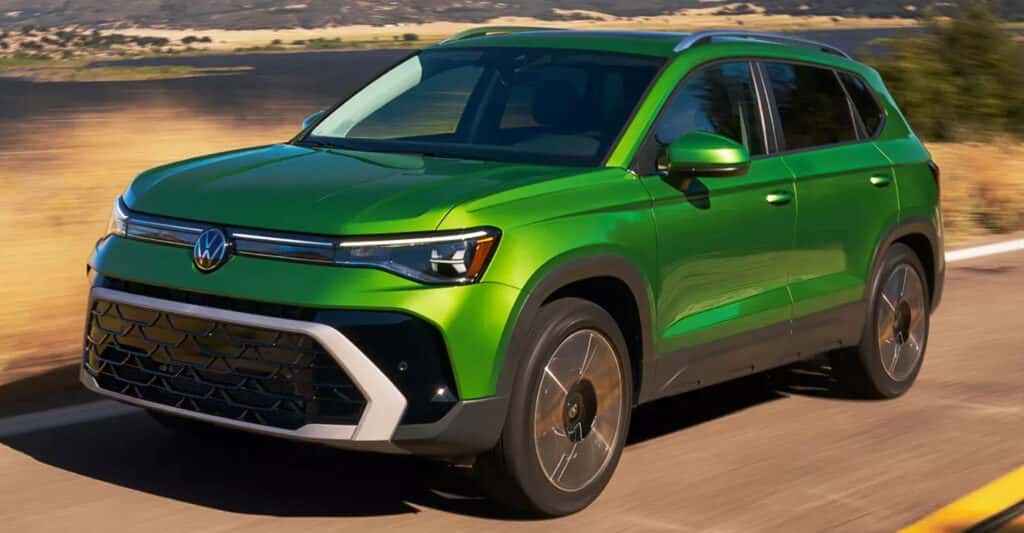
Let’s explore how these two popular crossovers compare across the categories that matter most to modern buyers.
Powertrain Dynamics: Turbocharged Punch vs. Mild Manners
The functional divergence between these two vehicles is immediately noticeable the moment your foot hits the accelerator pedal to merge into fast-moving highway lanes. The 2026 Volkswagen Taos comes standard across all trim levels with a highly refined 1.5-liter turbocharged TSI four-cylinder engine. For the 2026 model year, this power plant has been optimized to generate a spirited 174 horsepower and a robust 184 pound-feet of torque. Because turbochargers force pressurized air directly into the engine, the Taos delivers its maximum torque at low engine speeds, providing immediate low-speed throttle responsiveness. This allows you to zip through urban St. Louis intersections or overtake slow-moving commercial trucks with total confidence.
The Honda HR-V takes a far more conservative approach to engineering, utilizing a standard, naturally aspirated 2.0-liter four-cylinder engine that lacks any form of forced induction. This engine produces a modest 158 horsepower and 138 lb-ft of torque. Without a turbocharger, the HR-V requires you to press the gas pedal down heavily and rev the engine high into the RPM range to locate its peak power, which often translates into a loud, uninspired cabin buzz when attempting to quickly pass vehicles or climb steep highway grades.
Power delivery is further altered by the transmission architecture. Volkswagen has updated the entire 2026 Taos lineup—including models equipped with 4MOTION® all-wheel drive—to utilize an advanced, smooth-shifting eight-speed automatic transmission. This modern gearbox keeps the engine perfectly positioned within its optimal power band, maximizing both highway passing power and fuel management. The Honda HR-V, conversely, relies on a Continuously Variable Transmission (CVT). Lacking fixed physical gear ratios, the CVT can cause the engine to drone uncomfortably during hard acceleration, offering a less engaging and less responsive driving experience compared to the crisp gear changes found in the Volkswagen.
Fuel Efficiency and Daily Cost Management
An exceptional commuter car must deliver a composed driving experience while keeping your monthly fuel budget protected against fluctuating energy costs. Despite its superior horsepower and torque ratings, the 2026 Volkswagen Taos demonstrates an elite mastery of fuel management. Front-wheel-drive Taos configurations achieve outstanding EPA-estimated fuel economy ratings of up to 28 MPG in the city and a stellar 36 MPG on the highway, resulting in a combined rating of 32 MPG.
The Honda HR-V falls behind in everyday efficiency. Front-wheel-drive HR-V models earn an EPA-estimated 26 MPG in the city and 32 MPG on the highway, yielding a combined rating of 28 MPG. Choosing the available all-wheel-drive system drops the Honda ratings further to 25 city and 30 highway MPG. When you factor in year-round commuting across the St. Louis metropolitan loop, the highly efficient powertrain of the Volkswagen Taos keeps your total operational overhead lower over years of ownership, allowing you to spend less time stopped at the pump and more time enjoying the open road.
Ready to feel the immediate throttle response and premium refinement of a modern turbocharged SUV Don’t settle for reading numbers on a screen. Browse our inventory right now to explore available trim levels and find the perfect match for your daily routine!
Cabin Dimensions and Real-World Cargo Versatility
For local households managing weekend youth sports gear, large grocery hauls, or specialized luggage for extended road trips out of town, structural interior volume is a critical deciding factor. The engineering team behind the 2026 Volkswagen Taos capitalized on an optimized wheelbase footprint to maximize real-world passenger volume and storage adaptability.
The Taos passenger compartment provides an open, airy environment that offers 99.5 cubic feet of total passenger space, ensuring both front and rear occupants ride in total comfort. Behind the second row of seats, the Taos provides an expansive 27.9 cubic feet of dedicated trunk room. When you need to transport larger boxes, bicycles, or home improvement supplies, the 60/40 split-folding rear seats fold down flat with ease, instantly opening up a massive 65.9 cubic feet of total flat-floor cargo capacity.
The Honda HR-V struggles to match this level of material utility due to its tighter interior packaging. The HR-V provides a smaller 24.4 cubic feet of cargo room behind its rear seats, turning everyday packing into a challenging spatial puzzle. When its rear seats are lowered, the legacy Honda footprint restricts total maximum storage volume to a limited 55.1 cubic feet. This leaves the Honda HR-V with a visible deficit of over 10 cubic feet of maximum loading space compared to the Volkswagen Taos, heavily restricting your capacity for bulky items or extended vacation luggage.
Next-Gen Technology and Digital Cockpit Architecture
An SUV’s interior layout acts as your primary command center, dictating how comfortably you isolate yourself from the stress of a hectic daily commute. Every single 2026 Volkswagen Taos comes standard with the innovative Volkswagen Digital Cockpit system, replacing old physical analog needles with a high-definition digital display located directly in the driver’s line of sight. Front and center on the completely redesigned dashboard is a newly standard 8-inch floating touchscreen infotainment display. This driver-focused screen features standard wireless App-Connect functionality for 2026, allowing you to instantly project your Apple CarPlay® or Android Auto™ navigation maps and media playlists onto the dashboard without connecting a physical USB cable. Upgrading to the premium SEL trim unlocks the larger Volkswagen Digital Cockpit Pro display alongside a premium 8-speaker Volkswagen audio system.
The interior of the Honda HR-V features a clean layout, but its multimedia execution feels remarkably traditional. Baseline Honda HR-V trims come equipped with a small 7-inch color touchscreen display that can feel visually restricted when managing turn-by-turn navigation. To unlock a larger screen or wireless smartphone connectivity, buyers must stretch their financing budget to the top-tier EX-L trim, which features a 9-inch freestanding display. The lack of a standard, fully customizable digital gauge cluster across the HR-V trim line emphasizes just how far ahead Volkswagen is when it comes to standard, modern cabin electronics.
Advanced Safety Networks and Factory Safety Nets
Operating a vehicle safely in heavy traffic requires an intelligent assistance network that can anticipate hazards before they occur. Every 2026 Volkswagen Taos features the comprehensive IQ.DRIVE® driver assistance suite as a standard baseline. This electronic co-pilot includes:
- Travel Assist: Semi-automated driving assistance that coordinates adaptive cruise control and active lane centering to track highway lanes smoothly.
- Front Assist: Forward collision warning and autonomous emergency braking with pedestrian monitoring.
- Active Blind Spot Monitor: Alerts you to vehicles hidden in your blind spots and can apply gentle corrective steering counter-measures if you begin to drift.
- Lane Assist: Active lane-keeping system that monitors road markings to prevent unintentional lane departures.
While the Honda HR-V includes the Honda Sensing® package with basic pre-collision braking and adaptive cruise controls, its sensor tracking can sometimes result in sensitive audio chimes that disrupt cabin peace, and it lacks the seamless integration of Volkswagen’s standard semi-automated Travel Assist system.
The final point of divergence centers on the financial peace of mind provided by their respective manufacturer warranties. Honda supports the HR-V with a standard 3-year or 36,000-mile limited bumper-to-bumper warranty. Volkswagen shifts the narrative completely by backing the 2026 Taos with an exceptional 4-year or 50,000-mile limited warranty safety net. Furthermore, Volkswagen includes the Carefree Maintenance program, covering your factory-scheduled maintenance services at one year/10,000 miles and two years/20,000 miles at no additional charge, ensuring your household budget remains fully protected over the first two years of ownership.
Test Drive the Redesigned Champion at Suntrup Volkswagen
Are you ready to feel the spacious comfort, test out the smartphone wireless integration, and discover the bold styling of this exceptional compact SUV in person?
Our team at Suntrup Volkswagen is standing by to guide you through the ultimate walkaround experience. Stop by our showroom located right here in South County to explore the new lineup in person and take an interactive test drive.
More from Suntrup Volkswagen
Best Volkswagen SUV for Families: A South County Buyer’s Guide
Volkswagen’s SUV lineup covers more ground than most buyers expect, from the nimble Taos at the entry point to the full-size Atlas at the top, with the Tiguan and Atlas Cross Sport filling the middle. For families shopping in South County and across the St. Louis metro, that range is genuinely useful: it means there…
2026 Volkswagen Atlas vs. 2026 Chevy Traverse: Which Three-Row SUV Wins for St. Louis Families?
When you are shopping for a three-row family SUV, the 2026 Volkswagen Atlas and 2026 Chevrolet Traverse land in the same conversation for good reason. Both carry seven passengers, both tow up to 5,000 pounds when properly equipped, and both start right around $40,000. Look closer, though, and the differences start to matter. The 2026…
Why Buy Your Next Volkswagen From Suntrup Volkswagen in St. Louis
Choosing the right Volkswagen is one decision. Choosing the right dealer is another. For South County and South St. Louis drivers, Suntrup Volkswagen on S. Lindbergh Blvd. has built a consistent answer to that second question, backed by award-winning recognition from Volkswagen itself, a complete lineup of current models, and a service department built to…
0 comment(s) so far on 2026 Volkswagen Taos vs. Honda HR-V: The Ultimate Compact SUV Showdown